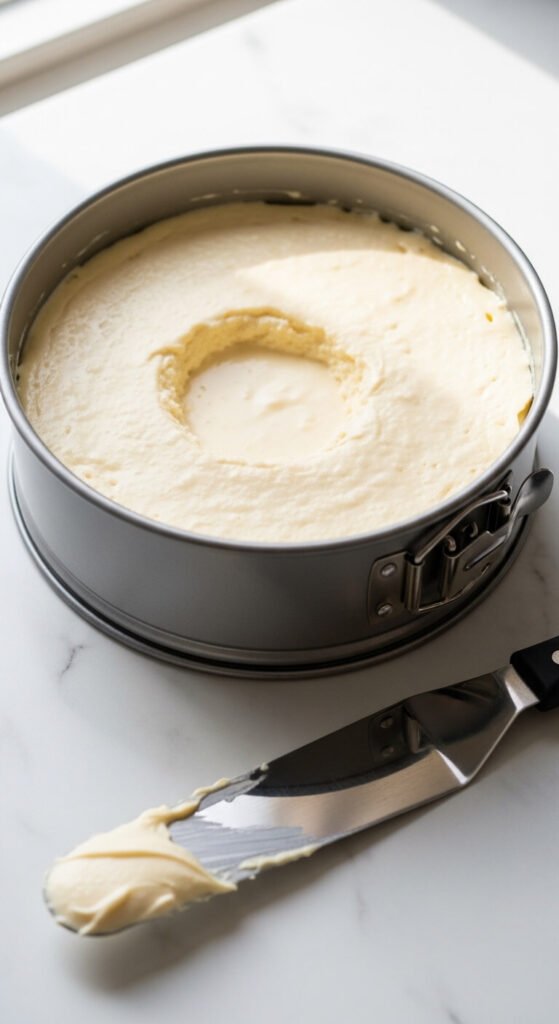
You followed the recipe. You whipped the cream, you beat the cream cheese, you folded everything together with the care of someone who really wanted this to work. And now you’re standing in front of a springform pan full of cheesecake filling that has the structural integrity of a milkshake. It’s not setting. It’s not firm. It pours when you tilt the pan. The guests arrive in three hours and your beautiful cheesecake is a liquid.
Here’s the thing — runny no-bake cheesecake is almost always fixable. And even in the cases where it can’t be fully rescued into a sliceable cake, it can absolutely be transformed into something genuinely delicious that nobody will know was ever a problem. Don’t throw it out. Read this first.
First — Figure Out Why It’s Runny
Before you fix the problem, spend 60 seconds diagnosing it. The cause determines the solution.
The most common culprits:
- Cream cheese was too warm. Room temperature is correct — but cream cheese that was left out too long or softened in the microwave becomes too loose to contribute structure to the filling.
- Heavy cream was over or under whipped. Under-whipped cream adds liquid rather than airy structure. Over-whipped cream breaks into butter and liquid whey, which floods the mixture.
- Low-fat cream cheese was used. Reduced-fat and spreadable tub cream cheese contain significantly more moisture than full-fat block cream cheese. That extra water prevents the filling from setting.
- Wrong type of heavy cream. Half-and-half and light cream don’t whip. Only heavy whipping cream with 36% or higher fat content produces stable peaks.
- Not chilled long enough. A filling that’s perfectly made but only refrigerated for two hours may simply need more time.
Identify which of these applies to your situation — then choose the corresponding fix below.
Fix 1 — Put It Back in the Freezer (The Fastest Solution)
If your cheesecake is assembled and simply hasn’t set after the minimum chilling time, this is your first move.
What to do:
- Remove any toppings already on the surface
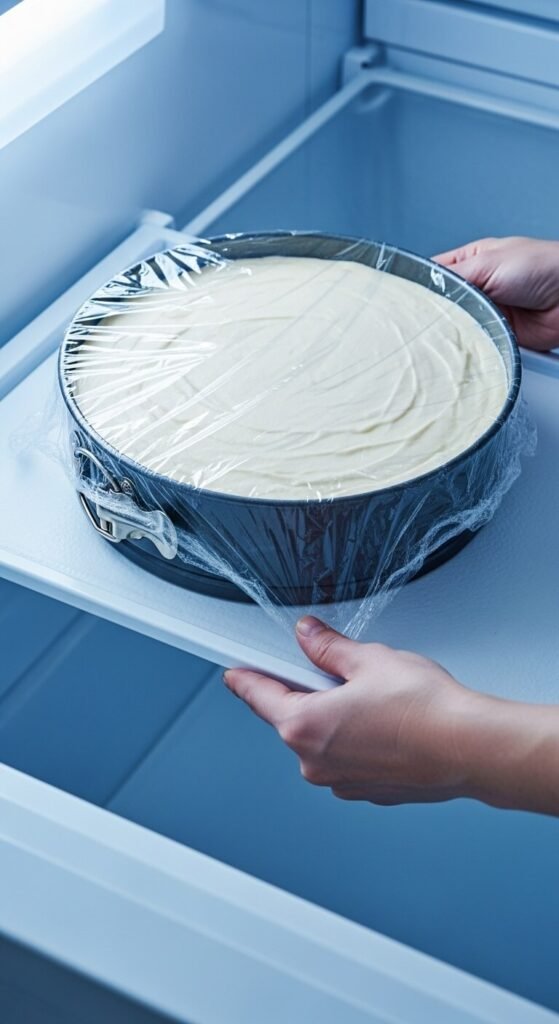
- Cover with plastic wrap pressed directly against the filling
- Place in the freezer for 45 to 60 minutes
- Transfer to the refrigerator for at least 30 minutes before serving
This two-stage process rapidly drops the temperature of the filling and firms up the fat in the cream cheese and heavy cream. The final fridge rest brings the texture back from frozen to perfectly cold and sliceable.
This fix works when the recipe itself was correct but the cheesecake simply needed more time and colder temperatures than your refrigerator alone could deliver on schedule.
Fix 2 — Add Gelatin to Rescue the Filling
If the filling is genuinely too loose — not just under-chilled — gelatin is the most reliable structural rescue available.
What to do:
- Scoop the soft filling out of the pan and back into a mixing bowl
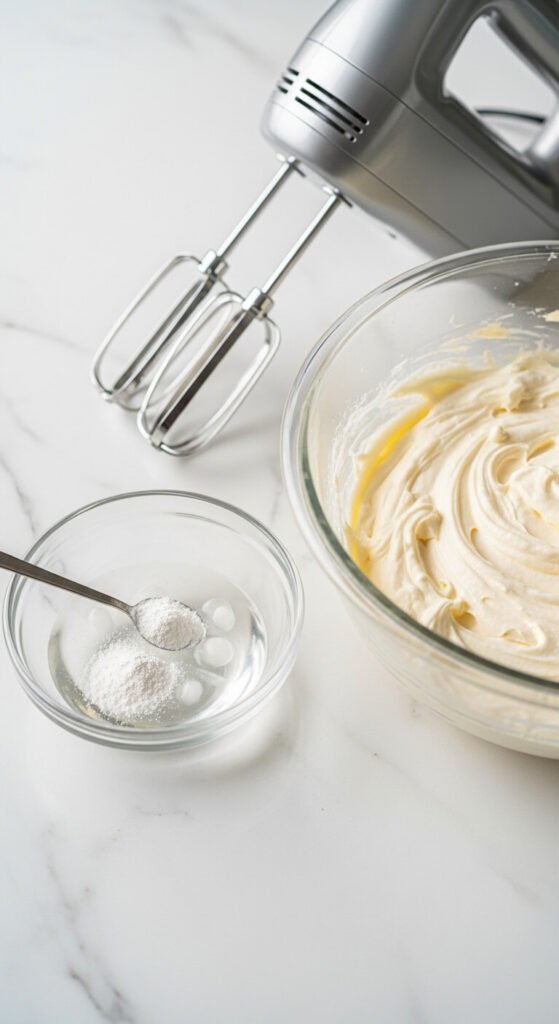
- Dissolve 1 teaspoon of unflavored powdered gelatin in 2 tablespoons of cold water in a small bowl — let it bloom for 5 minutes
- Microwave the bloomed gelatin for 10 seconds until just melted and clear
- Let it cool for 2 minutes — it should be liquid but not hot
- Pour the cooled gelatin into the soft filling and beat with a hand mixer on medium speed for 1 minute until fully incorporated
- Rinse the springform pan, re-press the crust if needed, and pour the filling back in
- Refrigerate for 3 to 4 hours or freeze for 60 minutes followed by 30 minutes in the fridge
The gelatin provides structural support that compensates for whatever fat or air ratio issue caused the original problem.
Fix 3 — Beat in More Cream Cheese
If you have an extra block of cream cheese on hand, this is the simplest structural fix with the least impact on flavor.
What to do:
- Take 4 oz (half a block) of full-fat cream cheese — cold, straight from the fridge
- Beat it alone in a clean bowl until smooth
- Add the loose cheesecake filling to the beaten cream cheese gradually, mixing on medium speed
- Taste and adjust sweetness with a tablespoon of powdered sugar if needed
- Return to the pan and refrigerate or freeze as directed above
The additional fat and protein from the cold cream cheese tightens the filling considerably. This fix works best when the original problem was low-fat cream cheese, over-softened cream cheese, or a recipe that was simply undermeasured on the cream cheese component.
Fix 4 — Whip Additional Heavy Cream and Fold It In
If the filling looks grainy, separated, or curdled rather than just loose, the heavy cream likely broke during whipping. The fix is adding properly whipped cream to reintroduce stable structure.
What to do:
- Whip ½ cup of cold heavy whipping cream to firm peaks in a chilled bowl
- Fold the newly whipped cream gently into the loose filling using a rubber spatula in large, sweeping motions
- Do not beat — folding preserves the air you just created
- Return to the pan and chill as directed
When the Cheesecake Can’t Be Saved as a Cake
Sometimes the damage is done and a sliceable cheesecake isn’t happening today. That’s okay — here are three delicious exits:
- Cheesecake parfaits: Layer the soft filling in glasses with crushed graham crackers and fresh berries. Refrigerate individual glasses for 30 minutes and serve as elegant individual desserts.
- Cheesecake dip: Transfer the filling to a serving bowl, refrigerate until as firm as possible, and serve with graham crackers and sliced fruit for dipping.
- Frozen cheesecake bars: Pour the filling into a parchment-lined 8×8 pan, freeze solid, and cut into bars. Serve directly from the freezer as a frozen treat.

Prevent This Next Time With These Simple Rules
Now that you’ve rescued this batch, here’s how to never need these fixes again:
- Use full-fat block cream cheese only — Philadelphia brand blocks, not tubs
- Pull cream cheese out 30 to 45 minutes before mixing — soft enough to beat smooth but not so warm it’s loose
- Keep heavy cream cold until the moment it goes into the bowl — cold cream whips properly; warm cream doesn’t
- Whip cream to firm peaks — the peaks should stand straight up and not droop
- Chill for a minimum of 6 hours — overnight produces the most reliable results
Your Cheesecake Isn’t Ruined — It’s Recoverable
A runny no-bake cheesecake feels like a disaster in the moment and turns out to be a very solvable problem in practice. The gelatin fix, the freezer method, and the cream cheese addition all work reliably — and the parfait transformation has saved many a dinner party dessert with nobody being any the wiser.
Save this article to your baking troubleshooting collection — because the one time you need it, you’ll need it urgently and you won’t want to search for it twice.